


BLOG
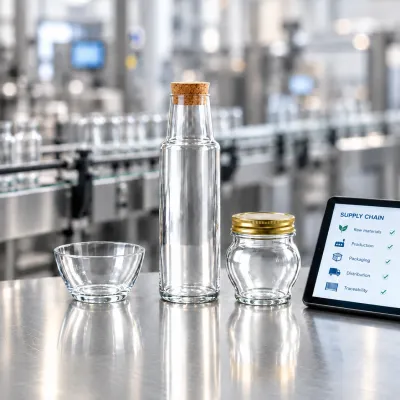
Choosing packaging for the food industry calls for a rigorous balance between product safety, regulatory compliance and supply chain efficiency. Glass is one of the benchmark solutions for food contact at industrial scale because it is 100% recyclable, endlessly. In production at Vetreria di Borgonovo, production offcuts and recovered glass go straight back into the melting cycle to become new glass. Because the material is regenerated in full, the containers obtained keep exactly the same technical and performance characteristics as those produced from virgin raw material. The physical and chemical properties that make glass an ideal material for preserving food therefore suffer no degradation, recycling cycle after recycling cycle.
Table of Contents
Food Safety and Chemical Stability: Food Contact Compliance
For buyers and R&D managers in food companies, neutrality of the packaging is an essential requirement for protecting shelf life and product integrity. On soda-lime glass, the conformity testing guidelines of Glass Alliance Europe describe a chemically stable material from which no significant levels of chemical elements migrate into the food. That is the property that counts over long storage periods.
The European framework for food contact materials, known in Italy by the acronym MOCA, is governed by Regulation (EC) 1935/2004 and sets strict limits on what packaging materials may release. Article 3 lays down a clear principle: under normal or foreseeable conditions of use, packaging must not transfer constituents to food in quantities that could endanger human health, bring about an unacceptable change in the composition of the food, or deteriorate its organoleptic characteristics.
On taste, glass requires no protective barriers or internal coatings. FEVE, the European Container Glass Federation, describes it as impermeable to both gases and liquids: oxygen does not get in, carbon dioxide does not get out, and the material does not absorb the compounds of the food it holds.
At national level, compliance is validated through the overall migration test set out in the Italian Ministerial Decree of 21 March 1973. Supply chain safety is further underpinned by the traceability obligation of Article 17, which is essential for tracing responsibility down to the batch. Choosing an industrial partner such as Vetreria di Borgonovo SpA, which holds FSSC 22000 food safety certification valid until 2027, gives purchasing departments documented procedural compliance.
The Impact of the PPWR: Strategic Advantages of Glass
The new European Packaging and Packaging Waste Regulation (PPWR, Reg. (EU) 2025/40) introduces regulatory asymmetries between materials, and places glass in an area of competitive advantage for procurement optimisation:
- Minimum recycled content: unlike plastic, the regulation sets no mandatory minimum share of recycled material entering glass production.
- Exemption from deposit return schemes (DRS): the obligations in force from 1 January 2029 for single-use plastic and metal packaging up to three litres do not apply to glass.
- System-level recycling targets: the European recycling target for glass rises to 75% by 2030. Responsibility for reaching that share falls on the Member States and on the consortium systems, partly relieving the individual company that places the packaging on the market.
The stringent new documentary obligations the PPWR brings in for August 2026 will nonetheless apply to every material, which makes it essential to rely on suppliers able to guarantee impeccable technical files.
Limits of Use and Operating Conditions
A comparison that is useful to a purchasing office also covers what the material does not do. Glass carries a higher transport weight than plastic and a fragility that affects handling and secondary packaging, and it is the same rigidity that holds the shape of the container and allows it to be washed and filled again.
Operating conditions are declared on the product data sheets. Food containers in the Igloo range hold refrigerator and freezer temperatures down to -20 °C, are dishwasher safe and may be used in the microwave, without the lid, only on defrost or low-power reheating programmes (500/600 W). Conventional ovens, open flames and electric hobs are excluded, and the instructions ask that thermal shock and standing the container on cold or damp surfaces be avoided.
One last element concerns documentation. A container with a lid is a two-material pack, and the lid carries its own documentary path: on Igloo containers it is made of BPA-free food grade plastic.
Sustainability and ESG: Cutting the Carbon Footprint
Glass is a permanent material, described by FEVE as endlessly recyclable with no loss of quality or of its intrinsic properties. This closed loop translates into direct benefits for the sustainability and decarbonisation strategies (Scope 3) of food companies. Using recovered glass, or cullet, in the furnace batch reduces the environmental impact of production:
- every additional 10% of cullet in the batch cuts direct CO₂ emissions by 5%;
- every additional 10% of cullet cuts furnace energy consumption by 2.5%;
- every tonne of cullet used replaces around 1.2 tonnes of virgin raw materials;
- the average recycled content in glass containers produced in Europe currently stands at 53.55%.
In Italy, the efficiency of the chain monitored by CoReVe points to a projected recycling rate of 82.1% for 2025, having avoided almost one million tonnes of CO₂ in 2023 alone. For companies in the preserved food industry, using these containers is reflected in the carbon footprint of the finished product.
Integrated Document Management for Secure Procurement
For purchasing offices in retail and in industry, the real test is documentary reliability. From 2026 the EU Declaration of Conformity (DoC) must refer to the specific packaging, supported by a precise technical file and by management systems that guarantee traceability down to the single batch.
Working with Gruppo Vetreria di Borgonovo means internalising that complexity. Because the whole supply chain is controlled in house, with production at Vetreria di Borgonovo SpA and any decoration at Decover Srl, the technical file for the complete packaging is generated and managed within a single corporate perimeter. The integration of certified management systems (ISO 14001 for the environment, ISO 50001 for energy and FSSC 22000 for food safety) avoids the handovers between separate companies that produce the documentary gaps typical of fragmented supply chains.
On the consumer side, packaging choice drives brand positioning. Research carried out by Ipsos Doxa for Assovetro, the Italian glass industry association, and presented in July 2026, gives glass 67% top marks on safety for health among Italian consumers and 68% among household purchasing decision makers, with comparable shares on environmental sustainability.
Optimise Your Packaging Procurement
Take control of food contact compliance: request the certifications of the Group and the conformity documentation, or get in touch about a custom project.

